From Breaks to Breakthroughs: How Artian Automates Trade Break Remediation for the Financial Services Industry
The Mounting Cost of Operational "Breaks"
Data sits at the core of every financial institution. And because most organizations manage more than one system of record, that data will inevitably diverge. These divergences (also known as "breaks,") are the physical manifestation of "dirty data" and systemic complexity. And while historically viewed as a back-office issue, breaks cause a significant tax on growth, agility, and regulatory standing.
The Butterfly Effect
A break occurs when two separate systems or sets of records that should match, don’t. Let’s use a mismatch between a Front Office risk view and a Back Office settlement position as an example. In this case, even a small misconfiguration or API failure can domino into a huge issue, rather than just forming an isolated incident.
Because of this, employees will sometimes bypass controls to pressure systems back into alignment, eventually creating an extremely unstable environment entailing the following: manual fixes that hide the true position of the firm, toil burden that inspires more human error and turnover, and in extreme cases, compliance exposures that can lead to large regulatory fines.
Together, we can transform the promise of AI into trusted automation for the most demanding industry in the world. Ready to join us?

The Economic Reality in 2026
The cost of this friction is no longer sustainable and research reports that as of 2025, global financial institutions faced nearly $4 billion in compliance-related fines, (many of which stemmed from inadequate data governance and reporting failures.) According to a report by ITIC, in just 2024, the average cost of application downtime in the financial sector exceeded $300,000 per hour, meaning every second spent on manual investigation is a direct hit to the bottom line. Today, the risk continues to grow. One of our focuses at Artian is turning these fragmented, risky processes into reliable, auditable, multi-agent systems. By moving from ad-hoc manual scripts to governed agents, financial firms that work with us can resolve these breaks in seconds rather than hours.
From “Toil” to “Traceability”: The Anatomy of Agentic Investigation
Traditional automation can’t keep up with the needs of financial operations. Data breaks will always require an investigation, context-gathering, and a type of reasoning that standard deterministic scripts don’t provide. While Robotic Process Automation (RPA) handles simple and repetitive tasks fairly well, it struggles with unstructured, judgment-heavy tasks that are needed for mission-critical and complex workflows that financial institutions face.
Why Raw LLMs and RPA Fall Short
While organizations have attempted to bridge this gap by applying raw Large Language Models (LLMs) to these workflows, these models lack the full-stack orchestration, domain-specific tooling, and data controls that are needed for regulated ecosystems. Without a governing harness, a raw LLM remains a black box that cannot meet the deterministic and resilient standards of a production trading floor. Artian fills this gap by providing a multi-agent system that combines the adaptability of generative AI with the rigor of graph-based workflows. Instead of a single model attempting to solve a problem, Artian deploys specialized agents that collaborate, share skills, and evolve across the workflow.
Artian’s Agentic Investigation Path
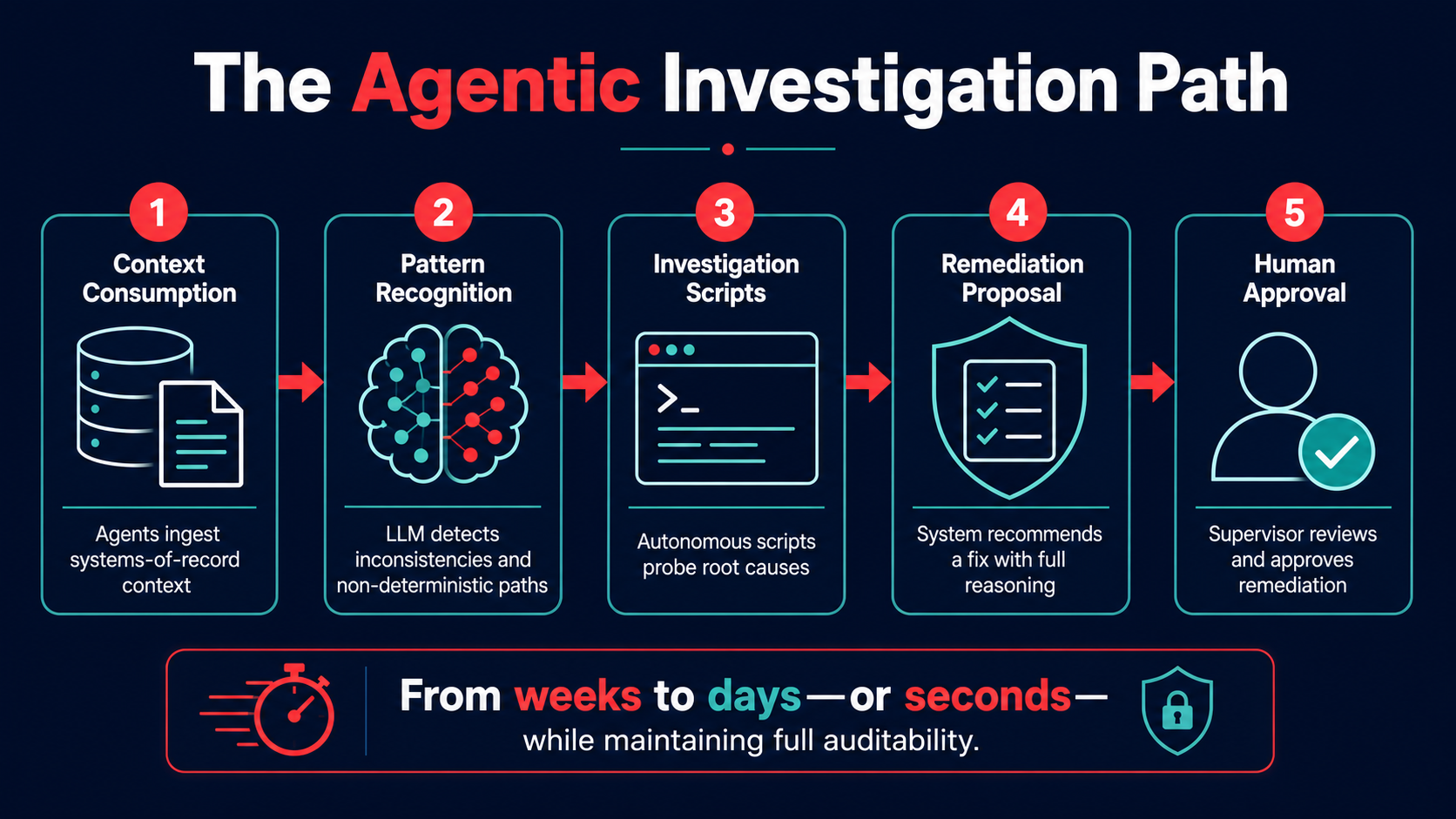
Our resolution of a break follows a transparent path so there’s never a question around logic or reasoning. For example, if a mismatch in a global settlement process is detected, our platform doesn’t just flag the error, but it also runs a thorough investigation. For many of our clients, this approach has turned a three-week investigation process into a matter of days (and in some cases, even seconds) significantly reducing toil while maintaining full auditability.
Here’s what it looks like in practice:
Governed Autonomy: Bridging the Gap Between Innovation and Compliance
Lack of control is one of the largest barriers we see stakeholders struggle with when it comes to adopting AI. Because of this, our framework is intentionally designed with transparent models bound by deterministic guardrails and human oversight. Because we come from financial organizations ourselves, we understand the regulatory standards against which AI needs to be measured.
This is achieved through these core technical pillars:
Structured Workflows: Planned workflows with a targeted risk-adjusted mix of LLM reasoning and deterministic steps
Isolation of Execution: Siloed agent runs with fine-grained data entitlements, selective memory, and no data leakage
Full Auditability: Every agent step journaled in detail for second and third-line defense
Scaling Resilience: Outcomes Across the Enterprise
One of the biggest challenges financial institutions face today is moving their AI pilots into production. Success is measured by the ability to deliver real business outcomes versus the novelty of the technology. Are you seeing reduced operational costs? Have you accelerated time-to-market? Do you have a fortified compliance posture?
Domain Applications and Strategic Wins
By automating the mechanical steps below, teams can handle higher volumes of work with fewer errors, allowing the organization to focus on growth rather than remediation.
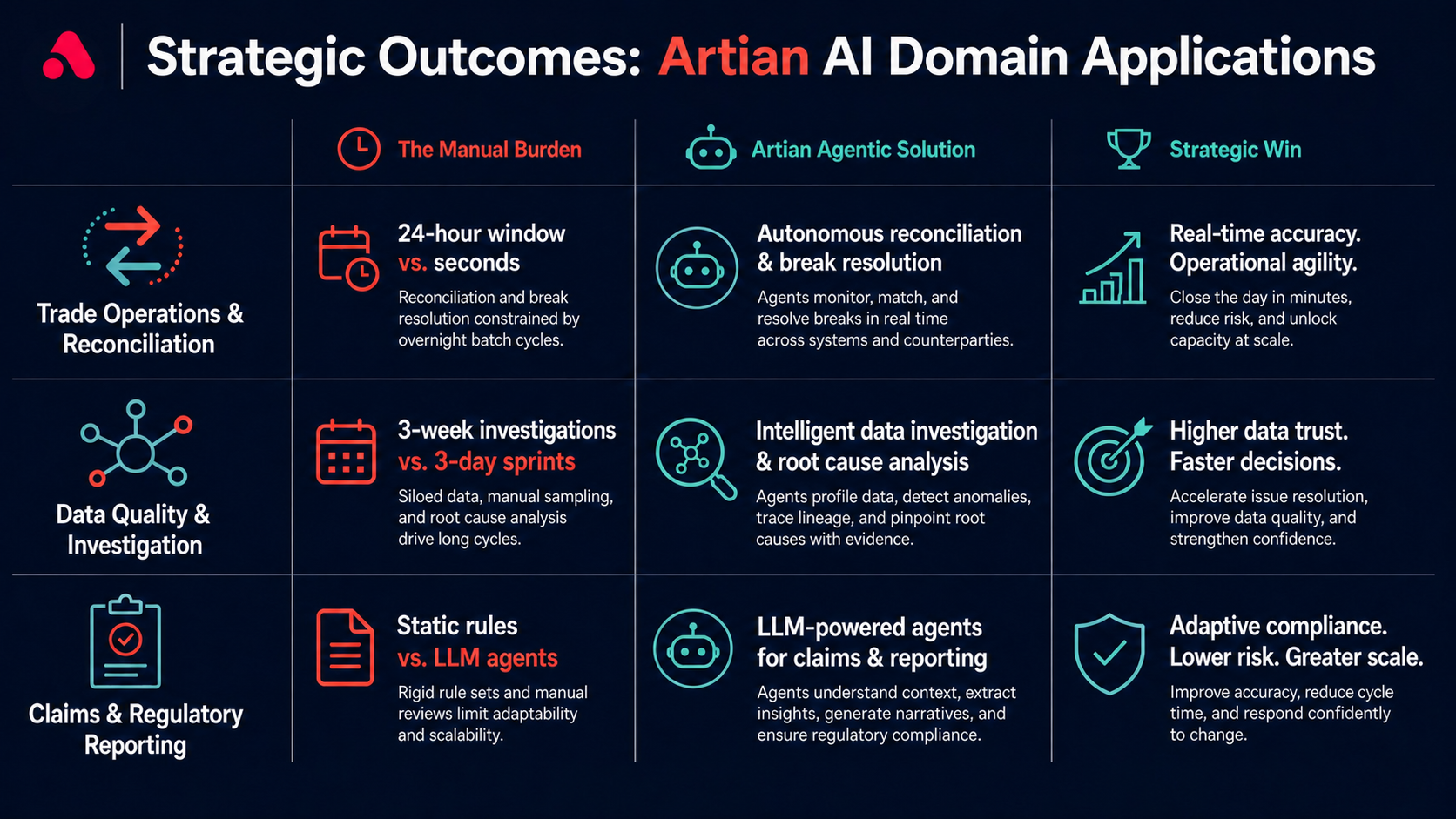
We’ve mentioned it before, but the financial services market is at an inflection point. As we explored through the lens of break remediation, the winners in this landscape will be the organizations that can successfully combine raw model power with controlled execution and regulatory compliance.
Together, we can transform the promise of AI into trusted automation for the most demanding industry in the world. Ready to join us?